
Disclosure: This post contains affiliate links. If you purchase through an Amazon link on this page, WVCardHub may earn a commission at no extra cost to you.
How to Store Your Cards Without Destroying Them
Nobody gets into card collecting planning to ruin their cards. And yet — bent corners, humidity damage, scratched holofoils, cards fused together after years in a shoebox — it happens constantly. Usually to cards people actually cared about.
The good news is that proper storage isn't complicated or expensive. You just have to know what actually matters and stop doing the stuff that quietly destroys collections over time.
The Silent Killers
Before we get into gear, let's talk about what actually damages cards, because most of the threats aren't obvious.
Humidity is probably the biggest one. Cards are made of paper. Paper and moisture don't have a good relationship. High humidity causes warping, soft corners, and in bad cases, mold. If you live somewhere that gets humid summers (and most of West Virginia qualifies), this matters more than you think. Cards stored in a basement or garage are at particular risk.
Heat is the other major one. Extreme temperatures cause cards to warp and can do a number on the surface over time. Don't leave cards in a hot car. Don't store them in an attic that hits 100°F every summer. This seems obvious until it isn't.
Direct contact with other cards causes micro-scratching over time — especially on holofoil surfaces, which are softer than they look. Loose cards sliding around against each other in a pile will show wear faster than you'd expect.
Light fades cards. Prolonged exposure to sunlight, or even strong artificial light over years, yellows the card stock and dulls colors. Keep displayed cards out of direct sun.
The Basic Setup
You don't need to spend a lot to protect most of your collection. Here's the standard layer-by-layer approach that most serious collectors use.
Step 1: Penny Sleeves — Your First Line of Defense
Penny sleeves are thin, clear plastic sleeves that go directly on the card. They're the most affordable protection you can buy and a non-negotiable first step before doing anything else with a card. They protect against fingerprints, dust, and surface scratches, and they're the correct prep for cards going into toploaders, card savers, or binder pockets.
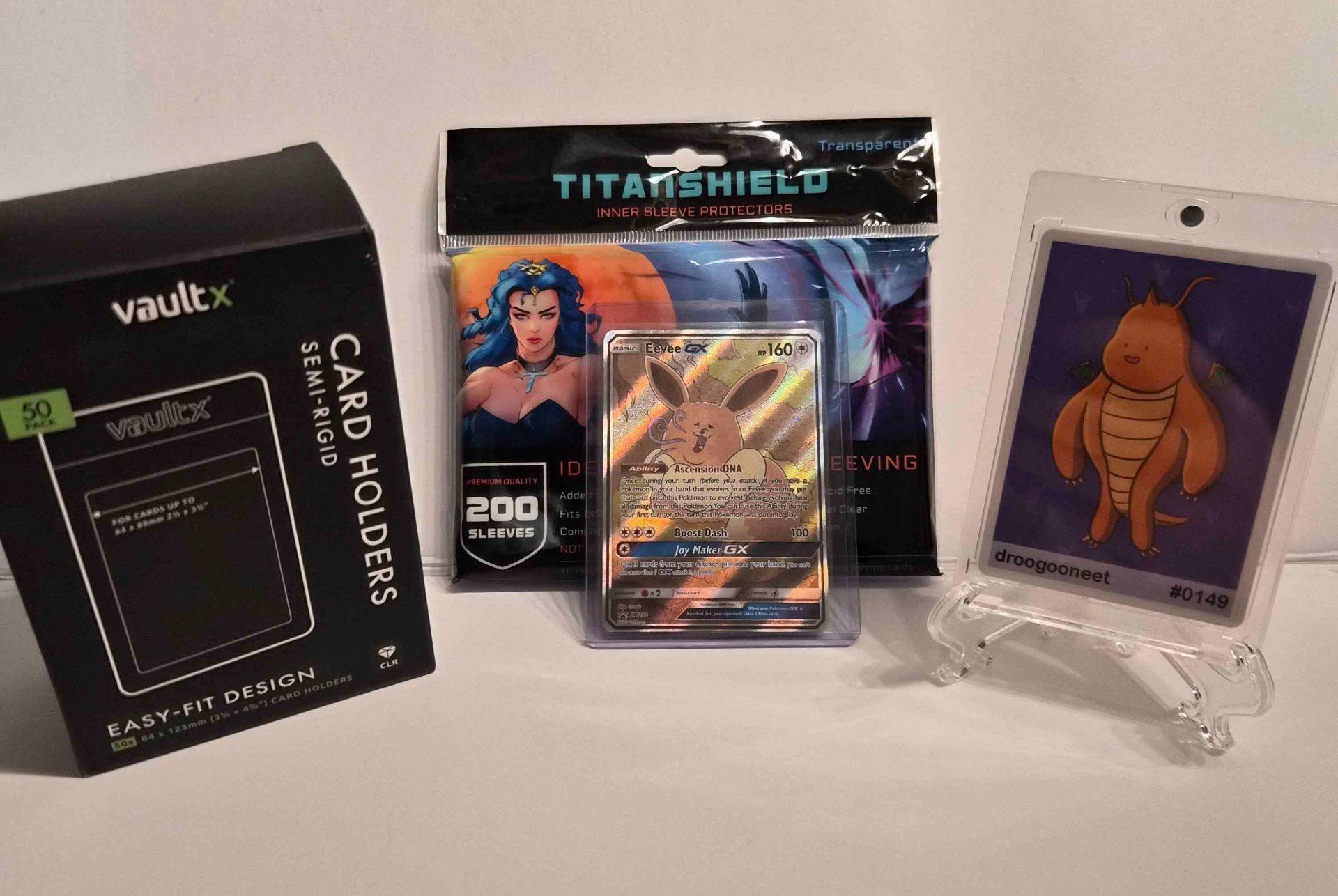
Vault X Penny Sleeves (200 pack) are made from clear, acid-free, PVC-free polypropylene with excellent clarity and a snug but not tight fit. Vault X has built a strong reputation in the hobby for delivering consistent quality at fair prices, and their penny sleeves are a go-to recommendation across the collector community.
Alternatives worth knowing:
- Ultra Pro Penny Sleeves (100ct) — probably the most recognized name in the hobby. Widely available at card shops and big-box retailers everywhere, acid-free, and reliable for bulk storage.
- BCW Standard Card Sleeves — a longtime industry favorite, especially popular with high-volume collectors and sellers. Slightly wider opening than Ultra Pro, which makes sleeving easier.
- Cardboard Gold Soft Sleeves — crystal clear, archival-safe, and a favorite among collectors who prioritize long-term preservation. A little pricier but consistently well-reviewed.
What to look for in any penny sleeve: PVC-free, acid-free polypropylene. Anything that doesn't specify this is a pass.
Step 1b: Double Sleeving — The Upgrade for Cards You Really Care About
If a penny sleeve is your first layer of defense, double sleeving is the armor upgrade. The idea is simple: you put the card into a snug inner sleeve first (called a perfect fit or exact fit sleeve), then slide that into a standard outer sleeve. The inner sleeve seals the card tightly so no dust or particles can sneak in from the bottom, and the combination of both layers dramatically reduces the chance of surface scratches — especially on holofoils, which are notoriously easy to scratch inside a loose sleeve.
Double sleeving is standard practice for high-value cards, binder collections you browse regularly, and anything going into a toploader that you want maximum protection on.
Vault X Exact Fit Sleeves (200 pack) are the inner sleeve to pair with Vault X penny sleeves. Made from 60-micron polypropylene with a precise fit for standard cards, they sit flush against the card with almost no wiggle room — which is exactly what you want. Slide that into a penny sleeve or a deck sleeve on top and you've got a noticeably more secure setup.
Alternatives worth knowing:
- Dragon Shield Perfect Fit Sleeves — widely regarded as one of the best inner sleeves available. Incredibly tight fit, crystal clear, and a favorite among competitive players and collectors who double-sleeve everything.
- Ultra Pro Inner Sleeves — widely available and affordable for bulk double-sleeving. A solid everyday option.
- KMC Perfect Fit Sleeves — popular in the MTG and Pokémon communities for their consistent sizing and clarity.
One thing to note: exact fit / perfect fit sleeves are sized for standard TCG cards (Pokémon, Magic, etc.) and are not suitable for sports cards, which are slightly thicker. For sports cards, stick with a standard penny sleeve and toploader combo instead.
Step 2: Toploaders — Rigid Protection for Cards That Matter
Once a card is penny sleeved, if it's anything you care about, it goes into a toploader. Toploaders are rigid plastic holders that protect against bends, pressure, and impact in a way a soft sleeve never can. The standard size is 3" x 4" and fits most trading cards.
Vault X Toploaders 35pt (50 pack) are consistently praised in the hobby for their premium-grade crystal-clear plastic and solid seamless build. They hold up over time and don't yellow the way cheaper options can. Multiple collector communities name them among the top recommendations for protecting cards you actually care about.
Alternatives worth knowing:
- Ultra Pro 3x4 Toploaders (100ct bundle) — the default at most local card shops. Widely available, reliable quality, and the safe standard choice for bulk storage.
- BCW 3x4 Toploaders — competes directly with Ultra Pro on price and is a favorite for sellers who ship high volumes. Clarity and rigidity are comparable, and they're often slightly cheaper in bulk.
- Cardboard Gold Toploaders — trusted by graders and serious collectors for archival-quality storage. Crystal-clear and a step up from the standard options.
A quick tip on storage: stand your toploaders upright in a box, like books on a shelf. Stacking them flat under weight can stress the cards inside over time.
Step 3: Card Savers — For Anything Headed to a Grading Company
If you're thinking about getting cards graded — sending them to PSA, BGS, or SGC — this is where card savers come in. A card saver is a semi-rigid holder that's softer than a toploader but still provides solid protection. PSA specifically requires them (or strongly recommends them over rigid toploaders) because graders can safely extract the card without risking corner or edge damage.
Put your penny-sleeved card into a card saver, and you're submission-ready.
Vault X Semi-Rigid Card Holders (200 pack) have the right amount of flex, a clean opening that's easy to work with, and the clarity you'd expect from the brand. A solid all-around option for collectors who submit regularly.
Alternatives worth knowing:
- Cardboard Gold Card Saver 1 (200ct) — honestly, the gold standard. Cardboard Gold invented the card saver format in 1987 and has sold over 500 million of them. PSA specifically names Card Saver 1 in their submission guidelines. If you're submitting to PSA, this is the safest call.
- BCW Semi-Rigid Card Holders — widely available, accepted by PSA, BGS, and SGC, and a reliable budget-friendly option for collectors who submit in volume.
One sizing note: Card Saver 1 fits standard trading cards (2.5" x 3.5") — that covers Pokémon, Magic, sports cards, and virtually every other standard TCG. You'd only need a different size for oversized or vintage formats.
Step 4: Binders — For Your Main Collection
For cards you want to organize and browse regularly, a quality binder is the right move. You're looking for side-loading pockets (so cards can't fall out), a zipper closure, and pages that are acid-free and PVC-free. Ring binders are going out of fashion for a reason — the rings can dent card edges if the binder is overfilled.
Vault X 9 Pocket Zip Binder is one of the most recommended products in the hobby right now. Zippered closure, hard covers made from their signature water-resistant Exo-Tec material, double-sided pages, side-loading pockets — it checks every box. Multiple collector reviews call it the best binder for the money after trying cheaper alternatives, and it holds 360 cards comfortably.
Alternatives worth knowing:
- Ultimate Guard ZipFolio — a premium option that collectors and MTG players particularly love. Made with high-quality "Xenoskin" faux leather that's water and scuff resistant. On the pricier end, but the build quality is exceptional and it holds up over years of regular use.
- Ultra Pro PRO-Binder (9 pocket) — a longtime staple with wide availability, consistent page quality, and side-loading pockets. A reliable choice that doesn't break the bank.
- Dragon Shield Codex Binder — popular among TCG players who bring their collections to local game stores and events. Durable, available in multiple sizes, and built to handle regular handling.
The Storage Hierarchy in Practice
Here's how most experienced collectors actually tier their storage:
Bulk commons and low-value cards — penny sleeve only, stored in a cardboard storage box with a silica gel pack. No reason to go further.
Mid-range cards and personal favorites — penny sleeve into a toploader, stored upright in a box or slid into binder pockets.
Binder collection you browse regularly — double sleeved (exact fit inner + penny sleeve outer) into your binder. The double layer protects against the friction of flipping through pages repeatedly.
High-value hits, holos, and anything display-worthy — double sleeved, then toploader. If they're graded, into a dedicated binder or hard case.
Grading submissions — penny sleeve, then Card Saver 1, then proper shipping prep.
You don't have to protect every common in your bulk box like it's a PSA 10 Charizard. The goal is to match your protection level to the card's value — and make sure the cards that actually matter to you never get neglected.
One More Thing: Silica Gel and Your Storage Environment
The best sleeves in the world won't help if you store your collection in a garage that floods every spring or an attic that turns into a sauna in July. Keep your cards somewhere with stable temperature and low humidity — a bedroom closet or shelf is usually fine.
But if you want to take it a step further, especially for bulk storage boxes or any area that gets humid, silica gel packs are a cheap and effective solution. You drop one or two into a sealed storage box and they quietly absorb excess moisture, keeping the internal humidity in check. West Virginia summers are legitimately humid, so this is worth taking seriously if your collection is in a room that doesn't have consistent A/C.
Dry & Dry 5 Gram Silica Gel Packets (50 pack) are one of the most collector-recommended options — they're color-indicating (they change color when they've absorbed their fill so you know when to replace or recharge them), food-grade safe, and rechargeable by tossing them in the oven at low heat. A pack of 50 gives you enough to cover every storage box in your collection for a few bucks.
A good rule of thumb: one 5-gram packet per 100-count storage box is plenty. For larger containers or a whole shelf of boxes, go up to 10–20 grams and check them every few months. Most packs can be recharged and reused multiple times before you need to replace them.
Cards are meant to be enjoyed. The right setup means you can handle them, show them off, and browse your collection without worrying every time you touch something. A little upfront investment in the right supplies pays off every time you pull out a card that still looks exactly the way it did the day you got it.
WV Card Scene is building a community around card shops, shows, and collectors across West Virginia. Whether you're just getting started or you've been in the hobby for years, there's a place for you here.